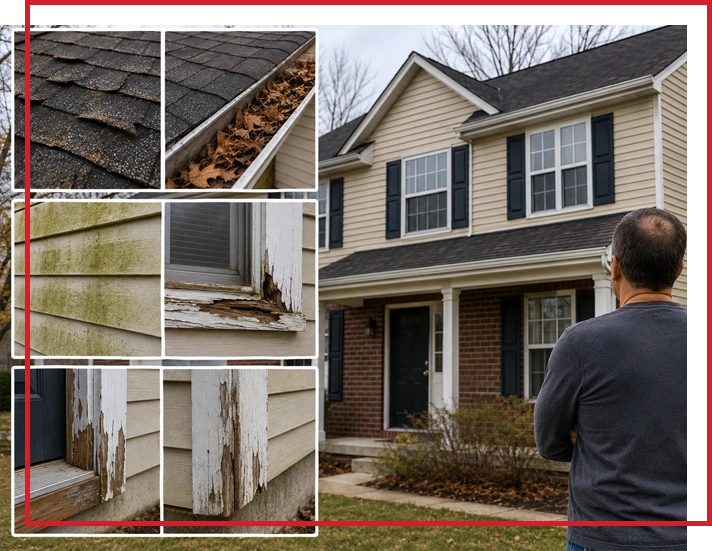
What Is Your Home Trying to Tell You?
Your home communicates with you every day—it just doesn’t use words. Instead, it leaves clues.
A gutter that suddenly overflows in one spot. A window that no longer opens as smoothly. A shingle that’s beginning to curl. A small stain that wasn’t there last year.
Most major exterior problems don’t appear overnight. They develop gradually, often giving homeowners subtle warning signs long before significant damage occurs.
Learning to recognize these changes won’t make you a contractor, but it will help you better understand your home and know when it’s worth taking a closer look.
1. One Gutter Always Overflows
Overflowing gutters aren’t always caused by leaves. A single section that consistently spills water could indicate improper pitch, a hidden blockage, loose fasteners, or even movement in the fascia board supporting the gutter system.
Watching for patterns is often more important than reacting to a single rainstorm.
2. A Window Suddenly Becomes Difficult to Open
Windows naturally expand and contract with seasonal temperature changes, but a window that suddenly sticks, binds, or won’t latch properly may indicate movement within the frame, moisture issues, or normal wear in the window hardware.
The important clue is the change—not necessarily the difficulty itself.
3. One Missing or Curled Shingle
A single damaged shingle doesn’t automatically mean it’s time for a new roof.
However, it does expose the roofing system beneath it to the elements. Left unaddressed, one damaged shingle can let water reach components that were never meant to be exposed.
4. Black Streaks on the Roof
Many homeowners assume black streaks are dirt. In reality, they often come from airborne algae that thrive in humid conditions.
While usually cosmetic, widespread streaking may indicate it’s time to evaluate the roof’s overall age and condition.
5. Chalky Residue on Your Siding
If you rub your hand across older siding and notice a white powder, that’s called oxidation.
It’s a normal part of aging for many exterior finishes, but heavy oxidation can also signal that the protective surface coating is wearing away.
6. Caulk That Keeps Cracking
Replacing cracked caulk repeatedly may not solve the underlying issue. Repeated failures can indicate ongoing movement caused by seasonal expansion, settling, or moisture.
The crack isn’t always the problem—sometimes it’s simply revealing one.
7. Rust Around Roof Flashing
Small rust stains around flashing can be easy to overlook.
However, flashing exists to direct water away from vulnerable areas. If corrosion progresses, water may eventually find a path where it doesn’t belong.
8. Snow Melts Faster in One Area of the Roof
As temperatures cool this fall, watch your roof after the first snowfall. Uneven melting patterns can indicate differences in attic insulation, ventilation, or heat loss.
While not every uneven melt pattern signals a problem, it’s often worth understanding why one section behaves differently than another.
9. Loose or Warped Siding
One loose panel after a windstorm may simply need to be resecured.
If multiple areas begin loosening or warping, however, it may indicate fastening issues, thermal movement, or moisture affecting the wall system behind the siding.
10. Water Stains Where the Roof Meets a Wall
Discoloration near roof-to-wall intersections can sometimes point to flashing concerns.
One often-overlooked component is kick-out flashing, which directs water into the gutter instead of allowing it to run behind the siding. This small piece of metal can play a big role in protecting a home’s exterior.
Did You Know?
Most major exterior failures begin as small changes that homeowners either don’t notice or assume are normal.
Learning to recognize these early clues doesn’t mean you need immediate repairs—it simply gives you a better understanding of how your home responds to weather, age, and seasonal changes.
A Minnesota Perspective
Central Minnesota homes experience dramatic temperature swings, heavy snow, spring rains, summer heat, and strong winds throughout the year.
These seasonal cycles cause roofing, siding, windows, doors, and gutters to expand, contract, and shed water in different ways. Taking a walk around your home each fall is one of the easiest times to notice changes before winter weather makes many exterior areas harder to inspect.
Listen to What Your Home’s Exterior Tells You
Your home is constantly giving you information.
The key isn’t assuming every change is a major problem—it’s learning which changes deserve a closer look.
Understanding these warning signs helps homeowners make informed maintenance decisions, ask better questions, and often address small concerns before they become bigger ones.
After all, one of the best ways to protect your home is simply learning how to read the clues it’s already giving you.
BD Exteriors has decades of experience with all kinds of roofing, siding, and other exterior issues in Central Minnesota. If you notice any warning signs, contact us today for a no-pressure repair quote!